Minima: Featherweight Eyewear—Light Frames, Lighter Lenses
If your glasses come off at 4 p.m. and leave two red craters where your nose used to be, you already know the problem. Here’s what you probably don’t know: it’s not just the frame. The weight riding on your face is frame plus lenses, and the heavier half of that equation is usually the one nobody mentions.
Fix both halves and something remarkable happens. The glasses disappear.
Why Weight Is Ruining Your Day
Gravity pulls your glasses down your nose every single minute you wear them. Nose pads dig in. Temples stretch, and the glasses slide down. Over time, you push your frames back up, and you will push them back up—ten, twenty times a day, because a slipping frame never stays put for long.
Heavy glasses aren’t just uncomfortable. They stop holding their adjustment. Every trip down your nose stretches the temples. Every push alters where the nose pads once rested. The fitting geometry your optician dialed in slowly degrades until you’re back at the dispensing table asking why they “just don’t fit like they used to.”
Lightweight gear breaks that cycle at the physics level. Less mass means less downward pull, less digging in, and less stretching out of adjustment. The fit you walked out with is the fit you still have six months later.
The Frame Side: Minima’s Percée and Solaire Collections
This is where Minima earns its reputation. The French maker has been building minimalist eyewear since its first rimless model appeared in 1994, and every frame is handcrafted to order in France—no solder joints anywhere, which matters more than you’d think for long-term durability.
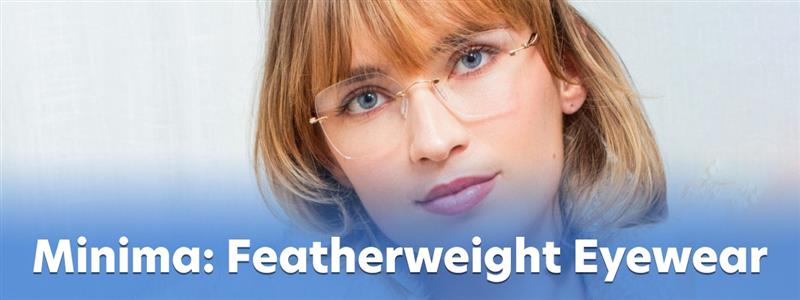
The Percée collection is the rimless heart of the line. Instead of a full rim surrounding each lens, tiny mounting elements—bridge and lugs crafted of beta-titanium, an elastic titanium alloy that flexes and springs back—attach directly to the lenses themselves. The finished frame weighs less than a quarter of an ounce (7 grams). That’s weight you’ll never feel—instantly. Less pressure on your nose, less temple bite, and lenses that remain where your optician intended, all day.
Durability
As with most things, there are plenty of styles “like” Minima’s, and they have given frameless and rimless eyewear a bad reputation when it comes to durability. Lenses break or end up with cracks around the holes and edges. They won’t stay in alignment, etc. That is most definitely NOT the case with Minima.
Having carried Minima eyewear since 1994, the opticians at Goodrich Optical have come to rely on Minima frames for our patients. Not only do they offer styles to fit the largest and smallest, widest and narrowest faces, but we have patients still wearing Minima frames they purchased 15 years ago, and they still look new. That is NOT the sign of a “fragile” frame. You’d be hard pressed to name another frame line with durability like that.
Fair Warning
Sage advice we offer anyone considering Minima frames: “You’ll never go back to another frame line once you’ve worn Minimas.” And it remains true to this day.
Two details worth knowing. First, most Percée models use Minima’s patented Diabolos hinge system with a screwless mount—precision construction that moves smoothly and stays that way. And second, sun clips are available, as a separate accessory, turning your Minima into your sunglasses without switching frames.
Speaking of sun: Minima’s “Solaire” collection applies the same gram-counting philosophy to sunglasses, so your summer pair can be as forgettable-on-your-face as your everyday pair.
(These collections are exclusive territory for us—more on that in a minute.)
Also Read – Titanium Frames vs. Plastic Frames
The Lens Side: Where Much of the Weight Lives
Here’s a truth big-box stores skip. Lenses usually outweigh the frame—often by a lot. Put heavy lenses in a 7-gram frame and you’ve built a race car towing a trailer. The frames never had a chance.
Our recommendation for lightweight builds is Trivex, a lens material originally developed as military transparent armor and adapted for eyewear in 2001. Three numbers tell the story:
- Density of 1.11. Specific gravity—ounce-for-ounce heaviness—of 1.11 makes Trivex the lightest prescription lens material on the market, about 16% lighter than standard plastic and meaningfully lighter than polycarbonate.
- Abbe value of ~44. Abbe value measures how badly a material splits light into color fringes at the edges of your vision. Trivex scores 43–45. Polycarbonate scores just 29–30, the worst of all lens materials. Your peripheral vision will notice the difference.
- Serious toughness. Trivex resists the star cracking around drilled holes you get with polycarbonate, which is exactly why it’s ideal for rimless styles like the Percée Collection—the lens itself becomes a part of the frame structure.
On polycarbonate, briefly and honestly: it’s the industry’s cheap default. It’s heavier than Trivex. It’s injection-molded, which leads to inherent waves and distortion. It fogs colors on the edges more than any other lens. And in our six decades of business, it simply hasn’t earned its reputation for durability. If quality of vision is a consideration, polycarb is the last material we’d consider. We only use it if a situation genuinely calls for it. And those are few.
For stronger prescriptions, high-index materials offer a thinner look. Their higher refractive index bends light more steeply, so a -6.00 lens comes out noticeably thinner—and thinner means less material, which means lighter weight. Result—high-index is often the featherweight champion despite being slightly denser.
The Other Side of the Lens: How Lenses Are Engineered Matters Too
Material is half the weight story. Design is the other half.
Conventional lenses come off a shelf of pre-molded curves—the lab picks the closest stock match and grinds your prescription onto it. Free-form lenses, sometimes called digital lenses, are different: a computer-controlled generator shapes the surface point by point, so the curve can be flattened and refined for your exact prescription instead of the nearest approximation. A flatter, aspheric surface means less bulge—thinner edges in nearsighted prescriptions, thinner centers in farsighted ones. Less material to begin with means less weight before the conversation even gets around to the material.
Free-form designs also account for how the lenses actually sit on your face—their distance from your eyes, and the tilt and wrap relative to your face—so the flatter, thinner form is computed for you, not for some mannequin head. And, you don’t trade clarity for thinness. This holds true for single vision and progressive lenses alike, and it’s why free-form is the standard for both here.
Either way, the pairing is what counts: light lenses in a light frame, made to your actual prescription and fitting data. Not pulled off some shelf.
Why This Combination Keeps Its Adjustment
Put it all together and the physics finally works for you:
- A quarter-ounce frame with Trivex lenses places a fraction of the normal load on your nose and ears.
- Gravity has much less to pull on, so the frames stop sliding down your nose.
- Beta-titanium’s springiness accepts rough handling better than most materials, yet when mistreated (stepped on, slept on, knocked off, dropped, etc.) can often be returned to service with only minor adjustment.
- Lighter lenses reduce stress on the frame mounting points, so the hardware stays tight and aligned.
End Result
The frame stays where we want it to. Where the fitting measurements were delivered. Fewer trips back for adjustments. Fewer red marks. Fewer of those evenings where you take your glasses off just to give your face a rest.
One Last Thing: Exclusivity and Craft
Goodrich Optical holds an exclusive arrangement with Minima that makes us one of the largest distributors of their eyewear in the United States—so this level of lightweight comfort isn’t something you’ll find online or in a dispensary down the road.
And because Percée frames are rimless, your lenses are genuinely custom. We don’t stop at helping you find the right lens type, we’ll also assist you in selecting the shape and size of your new lenses. We cut bespoke shapes to flatter your face and maximize function. We can finish them with hand-cut etchings, scallops, and facets. Or paint the edges and insert Swarovski crystals for the elegance you simply can’t get in a rimmed frame.
At Goodrich Optical, every prescription is inspected and verified before it leaves the office. And, we fit every frame to you at the dispensing table. We’ll never just hand you new glasses.
Comfort you notice starts with a pair that weighs next to nothing and stays exactly where we put it.
Book your appointment at Goodrich Optical and feel what featherweight really means.