
Polarized vs. UV Protection: Are They the Same Thing?
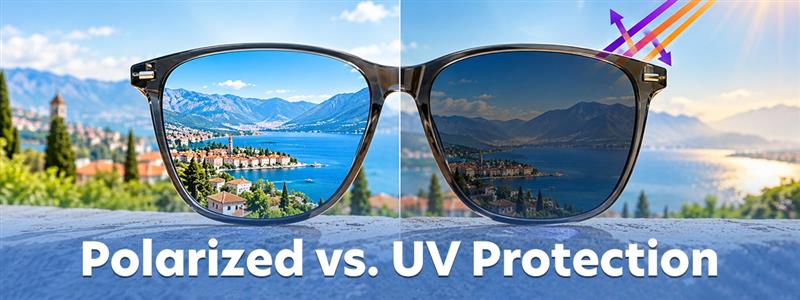
Here’s the mistake almost everyone makes at the sunglasses rack: they assume darker means safer. Or that “polarized” stamped on the temple means protected.
Neither is true. And the difference isn’t trivia — it’s the difference between comfortable vision and decades of accumulated eye damage you won’t feel until it’s too late to undo.
So let’s settle it, once and for all.
The One-Sentence Version
UV protection shields your eyes from invisible radiation. Polarization cuts glare. They’re two different jobs, done by two different features.
A lens can be polarized and still let UV through. A lens can block 100% of UV and not be polarized at all. Ideally, you want both in one pair — but if you’re ever forced to pick, UV protection wins. Hands down. It’s the one that actually protects your long-term eye health.
What UV Protection Actually Does
Ultraviolet radiation is invisible. You can’t see it, can’t feel it, and your eyes have no alarm system for it. But it’s busy anyway.
The American Academy of Ophthalmology (AAO) is blunt—prolonged UV exposure raises your risk of: cataracts, eye cancers, growths on the eye, and photokeratitis (sunburn on your cornea, and yes, it’s as unpleasant as it sounds). The Skin Cancer Foundation adds that at least 10% of cataracts are a result of UV exposure, plus a risk most people never think about: skin cancers on the eyelids, where sunscreen rarely gets applied and UV damage accumulates for decades.
Here’s the part nobody tells you: this damage is cumulative. Every sunny day on the golf course, every nature hike or bike ride, every weekend at the lake—it adds up on the same ledger. People of all ages should protect their eyes outdoors, and that includes kids, whose lenses actually let in more UV than adult eyes do.
What to look for: 100% UVA/UVB protection, or UV400, which means the lenses block all UV up to 400 nanometers. That’s the standard. If the label doesn’t say one of those things, or is vague — “UV absorbing,” “blocks most UV” — walk away. Unclear labeling on sunglasses is a real consumer trap.
And one more myth to kill: clouds don’t block UV. You need sunglasses on overcast days too.
What Polarized Lenses Actually Do
Polarization is a comfort feature, not a health feature — and I say that as someone who considers it money well spent.
Sunlight scatters in every direction. But when it bounces off a road, windshield, water, or snow, it becomes horizontally concentrated — that’s glare, and it’s brutal. Polarized lenses contain a filter that blocks most of that reflected light. The result:
- Sharper contrast and visual clarity
- Less squinting, less eye strain
- Dramatically better vision on water, snow, and wet pavement
- Safer, more comfortable driving on bright days
Ask any angler or boater. Once you’ve watched fish through polarized lenses, you’ll never fish without them. Same goes for cycling, golf, skiing, and highway commutes heading west at 5 p.m.
So Which Do You Need?
Here’s the truth of it: this is rarely an either/or choice. Modern sunglass lenses deliver both — UV protection and polarization — in the same pair, prescription or plano. There’s no good reason to settle for half the package.
But if you’re stuck choosing (think budget bin at the convenience store), the math is simple:
- UV protection prevents disease. Non-negotiable.
- Polarization prevents squinting. Wonderful, but optional.
Cheap tinted lenses with no UV rating are the worst of both worlds: they dim visible light so your pupils dilate behind them, while offering you no verified UV barrier at all.
Tips from My Dispensing Desk: practical reality.
Polarization blocks glare by wave orientation; UV protection blocks radiation by spectral absorption. Separate mechanisms, separate engineering.
Most legitimate polarized sunglasses sold through professional channels do also carry UV protection, because reputable makers include UV absorbers in the lens material as standard practice. The danger case is unbranded, uncertified, or counterfeit product — which is precisely the segment where “polarized” gets stamped on as a marketing sticker without the spectral protection behind it. If you’re unsure about the quality or UV protection of your sunglasses, consulting an optometrist in Lansing can help you choose reliable eyewear and verify that your lenses provide adequate protection.
Also Read – The Truth About Blue Light Filters
The Quick Answers
Q1). Are polarized and UV-protective sunglasses the same?
No. Polarization reduces glare. UV protection blocks ultraviolet radiation. Plenty of lenses have one without the other. The good ones have both.
Q2). Do polarized sunglasses automatically protect me from UV?
No — and this is the most expensive misconception in the sunglass aisle. Polarization is a glare filter, not a radiation shield. Check the spec for 100% UVA/UVB or UV400 before you buy.
Q3). Can I drive in polarized sunglasses?
Yes, and on bright highways they’re often the better choice.
Q4). What does UV400 mean?
The lenses block ultraviolet radiation up to 400 nanometers — which covers both UVA and UVB. Along with “100% UVA/UVB,” it’s the label you’re looking for.
Q5). Should kids wear sunglasses?
Absolutely. We’re emphatic on this — young eyes are more vulnerable to UV there is emphatic on this — young eyes are more vulnerable to UV than adult eyes, and the damage bank starts early. Hats help too.
Your eyes deserve expert care. Schedule your exam at Goodrich Optical today.