
Why Your Everyday Glasses Are Useless on the Field
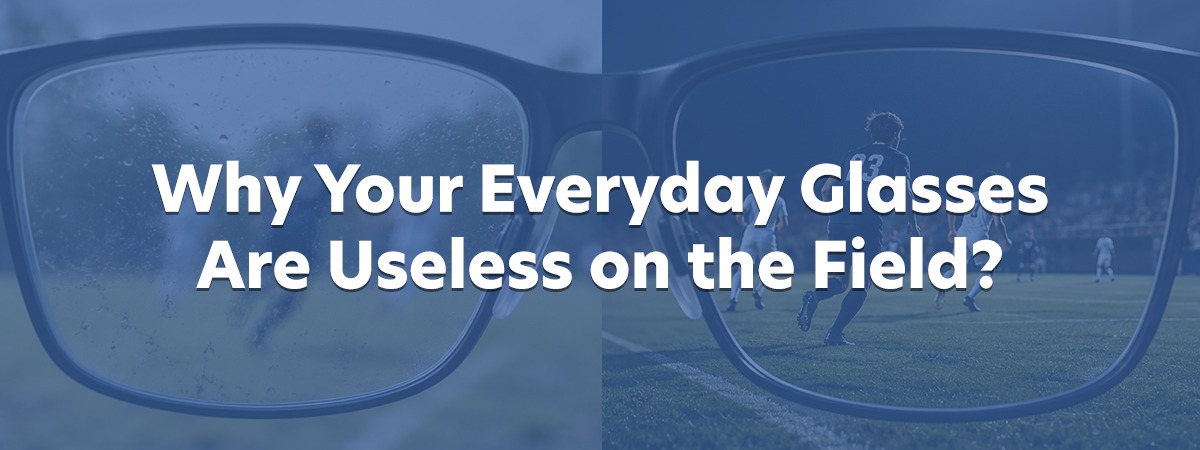
Ever wonder why your regular glasses fail when you hit the court? Here’s the brutal truth about athletic eyewear vs. daily wear.
So, You Think Your $200 Frames Can Handle a Tennis Ball?
Let’s be real for a second. You walk into Goodrich Optical looking for something that looks sharp for the boardroom or the beach. Maybe you want a rimless look that screams sophistication, or perhaps a thick acetate frame that says, “I take my prescription seriously.” And for 99% of your life? Those frames are perfect. They sit comfortably, they correct your vision, and give you, that look. But then, you strap them on to play a casual round of tennis, go for a jog, or shoot hoops with your kid, and within ten minutes, everything goes wrong.
They slide down your nose. They fog up so bad you might as well be blind. Or, worse yet, a stray ball—or even a rogue elbow in a crowded pickup game—smashes right into the temple, cracking the lens and knocking you out cold.
This isn’t just about comfort; it’s about survival. The gap between what an everyday wearer needs and what an athlete demands is massive, and it’s a gap that gets people injured more often than we’d like to admit. If you think your standard progressives are going to cut it during a high-intensity workout, you’re playing with fire.
Why? Because the human body moves differently when you’re competing versus when you’re commuting. The environment changes. The forces applied to the lenses change. And the consequences of failure change from “minor annoyance” to “emergency room visit.”
As an industry veteran who’s seen it all, I can tell you that athletes don’t just need better vision; they need vision that survives the chaos. Let’s break down exactly what separates the champions from the casualties.
Fact #1: Impact Resistance Isn’t a Luxury, It’s a Mandate
The first thing to understand is that everyday eyewear is designed for static safety. Your daily glasses are there to protect your eyes from dust, wind, and maybe a low-level, accidental bump. They meet basic FDA standards for impact resistance. Good stuff? Sure. Is it enough for sports? Absolutely not.
When you’re playing sports, especially racquet sports, basketball, or anything involving projectiles, the force hitting your eye can be staggering. A baseball leaving a bat at 90 mph isn’t just a heavy object; it’s a kinetic missile. Even a tennis ball traveling at 60 miles per hour carries enough energy to cause a retinal detachment if it strikes the eye directly. Standard plastic lenses can crack, shatter, or worse, fragment. Glass lenses? Forget it. They turn your face into a minefield of shards.
Athletic eyewear, specifically those rated ANSI Z87.1+ (the high-velocity impact rating) or the even stricter Z87.2, uses materials and construction methods that everyday frames simply don’t bother with. We aren’t just talking about the lens material here; we’re talking about the geometry.
Regular frames have temples (arms) that come straight back. They rely on friction and the curve behind your ear to stay in place. In sports, that friction can be nonexistent because you’re sweating, and the curve of your ear is irrelevant when your head is whipping around.
Athletic frames use wrap-around designs that distribute impact force across the entire bridge and temples, often incorporating rubberized nose pads and temple tips that lock onto the skin rather than slipping.
Think about the last time you tried running in a nice pair of wire-framed glasses. Did they slide? Were you constantly pushing them up your nose? Now imagine a tennis ball hits the side of those sliding frames. The frame acts as a lever, driving the sharp edge of the metal or the cracked plastic directly into your cornea. That is how injuries happen, and sight is lost.
High-performance eyewear eliminates the leverage points. They are constructed to flex, to absorb the shock, and to return to shape. Some use Grilamid or TR-90 plastics that are nearly indestructible. Others use silicone gaskets that seal the eye area, preventing debris and sweat from entering while ensuring that no matter how you move, the lens stays exactly where it needs to be: in front of your pupil.
It’s a harsh reality check: if your glasses break during a game, you’re not just losing a fashion accessory; you’re losing your vision for the rest of the match, and potentially causing permanent damage. Everyday wearers trade convenience for style. Athletes trade style for survival. There is no middle ground when a 50-mph projectile is flying at your face.
Fact #2: Stability and Fit Beat Style Every Single Time
Let’s talk about fit. This is where the dry humor kicks in because I’ve watched so many people try to wear “fashionable” glasses for sports and end up looking like a confused turtle trying to swim upstream.
Everyday eyewear prioritizes aesthetics. The manufacturer wants the frame to hug your face in a way that looks good in the mirror. They don’t necessarily care if the frame tilts slightly when you look down at a computer screen, because that’s a natural, controlled movement.
Athletics, however, involves erratic, violent, and unpredictable movements. Your head is bobbing, weaving, turning, and accelerating at rates that standard frames were never engineered to withstand. When you jump for a rebound on the court, gravity pulls your head down, but momentum throws it forward. A standard frame will slide forward, pinching the bridge of your nose until you see stars, or slip completely off your face.
Have you ever tried to adjust your glasses mid-game? Not impossible. You lose your rhythm, your focus breaks, and suddenly you’re standing on the sideline nursing a sore nose instead of playing.
Athletic eyewear solves this with a philosophy called “lock-down stability.”
- The Wrap Factor: Most performance frames offer a significant wrap-around angle, often exceeding 18 degrees. This isn’t just for a cool look; it changes the center of gravity. By curving the lens around your face, the weight distribution shifts, making the glasses harder to dislodge in vertical motion.
- Hydrophilic Materials: Remember those soft, squishy nose pads on sports glasses? That’s not just comfort; it’s traction technology. Many modern athletic frames use hydrophilic rubber, which actually gets stickier when it gets wet with sweat. Your everyday rubber pads get slippery when you sweat. Sports pads get aggressive. It’s a small detail that makes a world of difference when you’re drenched in humidity.
- Temple Tension: The arms on sports frames are tighter and often feature adjustable tension screws or flexible hinges that lock into place. They don’t rely on your ear shape; they clamp down. Some even include retention cords or elastic bands that go around the back of the head. It might look a bit utilitarian, almost military, but when you’re diving for a save, that cord is the only reason your glasses stay on.
Then there’s the issue of “pupil centration.” In regular progressive lenses, your optical centers are calibrated for a specific viewing distance—usually straight ahead or slightly down. If you tilt your head up or down, or if the glasses slide down your nose, your pupil moves out of the sweet spot. For a driver or a reader, this means blurring. For a basketball player, it means missing the rim entirely.
Sports optics are often single-vision or specially designed occupational lenses with a wide field of view. They are optimized for peripheral vision because athletes need to see the whole court, not just the ball. If you try to wear your progressive bifocals for sports, you’re effectively blinding yourself in your peripheral vision whenever you move your head. The distortion in the lower part of a progressive lens is useless for tracking a fast-moving object.
So, the rule is simple: If it slips, it fails. If it distorts, it fails. Your fashion frames are designed to look good in a still photo. Athletic frames are designed to function while you’re shaking apart.
Fact #3: Environmental Adaptation is Non-Negotiable
Now, let’s address the elephant in the room: the elements. Or in our case, the sun, the rain, the wind, and the sweat.
Your everyday glasses assume a relatively controlled indoor climate or a mild outdoor stroll. They assume you won’t be staring directly into the sun for 45 minutes straight while perspiring heavily. They also assume that fogging is a rare inconvenience caused by putting on a mask, not a constant threat to your performance.
For an athlete, the environment is a hostile adversary.
- Light Management: Sun glare is a nightmare for visual processing. When you’re playing outdoors, the sun isn’t just a light source; it’s a weapon that washes out contrast. A baseball against a bright sky becomes invisible. A tennis serve looks like a blur. Polarized lenses are essential for reducing horizontal glare from surfaces like water, snow, or even pavement. However, standard polarized sunglasses can sometimes mess with LCD screens or depth perception if not calibrated correctly. High-end sports lenses use specialized tint technologies that enhance contrast specifically for the colors of the ball and the playing surface, not just darken the world. Photochromic lenses (that darken in the sun) are popular, but they often react too slowly for athletes moving between shade and direct sunlight. An athlete needs instant adaptation.
- Fog Control: This is the silent killer of performance. When you exercise, your body heat rises. Your breath moisture increases. If your glasses seal perfectly (which they should), the heat and moisture get trapped between your face and the lens. Condensation forms instantly. You go from seeing clearly to seeing nothing. Standard anti-fog coatings wear off quickly under intense conditions. Athletic eyewear often incorporates permanent anti-fog treatments embedded into the lens material or venting systems built into the frame that allow airflow without letting debris in. Without these, you’re playing blind half the game.
- Sweat and Debris: Salt from sweat corrodes standard metal frames over time, but more immediately, it ruins the optical clarity. Water spots, streaks, and grime accumulate rapidly. Sports frames are designed to be hosed down or wiped clean without damaging the coating or the hinges. They are rugged. They are meant to be abused.
There’s also the matter of UV protection. While most clear lenses today offer UV blocking, they don’t always block 100% of the harmful rays if the fit isn’t tight. With a large gap between the lens and the face, UV rays can reflect off the sides and enter the eye from behind. This is a major risk for long-term eye health, leading to cataracts and macular degeneration. Wrap-around sports frames eliminate this gap, providing a shield that blocks UV rays from every angle.
It’s not just about seeing better; it’s about protecting the eye itself. You wouldn’t run a marathon in sandals, right? Don’t run your marathon in sunglasses that let UV rays sneak in from the side or fog up after five minutes.
Conclusion: Upgrade or Get Left Behind
Look, I’m not here to convince you that you need a custom pair of WileyX’s to walk the dog. If you’re grabbing the trash, keep doing what you’re doing. Your everyday glasses do a fine job for everyday life.
But the moment you step onto a court, a field, a trail, or the range, the rules change. The physics change. And, the stakes change. Athletes need eyewear that resists impacts, locks in place, and adapts to your environment. They need gear that understands that “style” is secondary to “function.”
If you’re an athlete who’s been struggling with slipping eyewear, fogged lenses, or that scary feeling of a ball coming right at your face, it’s time to have a serious conversation with a certified optician in Lansing, here at Goodrich Optical. We’ve got forty years of experience in optical diagnostics, and we’ve seen every mistake in the book. We know exactly what works, and we know exactly what fails.
Don’t let poor eyewear cost you the game, or worse, your vision. Whether you’re a weekend warrior or a pro competitor, your eyes deserve equipment built for the challenge. We can help you find the perfect balance of high-performance optics and comfort that fits your specific sport.
Also Read – Choice Between Eyeglasses and Contact Lenses
Book your appointment at Goodrich Optical today. Let’s get your eyes ready for the action.
FAQs
Q. Why can’t athletes simply wear regular sunglasses?
Regular sunglasses are designed for casual use at the beach or mowing the lawn. They lack the impact resistance, secure fit, and specialized lens technologies needed for athletic performance and safety.
Q. What lens material is most commonly used in sports eyewear?
Polycarbonate is most commonly used in sports eyewear because it is lightweight and highly impact-resistant. At Goodrich Optical, we go a step further, because we include visual performance as a required standard for they eyewear we offer. Givern the choice, Trivex offers the impact resistance of polycarbonate, is lighter weight AND has far better visual performance characteristics.
Q. Are polarized lenses always best for athletes?
Not always. They cut glare beautifully—that’s the whole point. But here’s the catch: polarization can sometimes make it hard to read LCD dashboards or see an icy patch on the road. For golf, they hide subtle water hazards and interfere with reading a green. Some athletes prefer non-polarized options depending on the sport and visual requirements.
Q. How often should sports eyewear be replaced?
Replacement depends on usage, wear, and damage. Unless you’re hitting them with a baseball bat, they last longer than your running shoes. But here’s the thing: plastics degrade over time, scratches accumulate, and your prescription changes (especially as you head into your 40s and 50s). Give us a shout for an annual checkup. If the frames feel loose or the lenses look dull, it’s time for an upgrade. Don’t wait for the crack to happen mid-match.
Q. Are contact lenses safe for impact sports?
They’re fine for casual runs or yoga, but for anything where debris flies—think tennis, racquetball, or baseball—they offer zero protection. A stray ball won’t just knock your contacts out, it could crush your eye socket, or worse. Your best bet is a hybrid approach: contacts under protective sports glasses. You get the vision and a shield against disaster.