
Will I Still Need Glasses After Cataract Surgery?
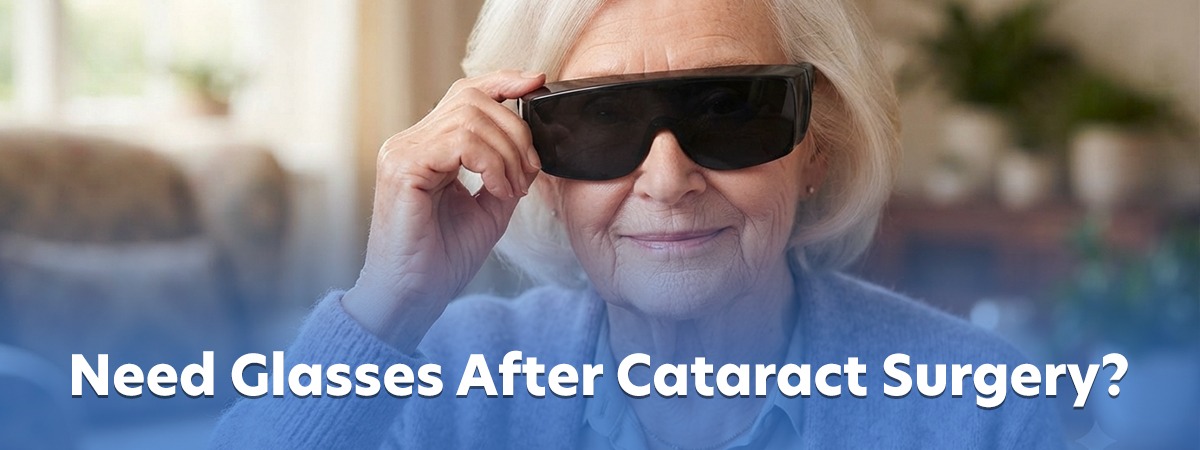
A question many patients have asked, usually while leaning forward like they’re sharing a secret: “So after cataract surgery, Will I still need glasses?”
I wish I could answer with a simple yes/no, but that would be dishonest. And after 40-plus years fitting eyewear and managing post-op patients, they know, at Goodrich Optical, “we call ‘em like I see ‘em.”
The truth? Cataract surgery is one of the most successful procedures in all of medicine. Success rates hover between 98 and 99%. It restores clarity, sharpens contrast, and in many cases, can dramatically reduce your dependence on glasses. But “reduce” and “eliminate” are two different words for a reason.
What the Surgery Actually Does
The natural lens of the eye clouds as we age. It’s known as a cataract. A surgeon removes it, drops in a shiny new intraocular lens (IOL), and boom — you’ve got vision again. Takes about 20 minutes.
But here’s the part many people miss: That IOL isn’t magic. It’s a tool. And like any tool, the right one depends on the job requirements.
Some Folks Still Reach For Their Glasses
Here’s why.
Lens type matters — A LOT.
The standard monofocal IOL gives you crisp vision at one point, usually distance. You’ll see fine to drive, watch TV, yell at the kids on your lawn, etc., but try to read the menu at Olive Garden? Not happening.
Here’s where our experience pays dividends. A monofocal IOL is by far the most frequently chosen IOL type used in cataract surgery. Why? Because it is the lens most insurance plans will cover, with the lowest out-of-pocket expense. That’s not to say it’s a poor choice. It’s not.
The reality is many people associate glasses with who they are. I can’t tell you how many people have said, “No one would recognize me without glasses”, or “I’ve worn glasses all my life; they don’t bother me”. All valid observations worth thinking about.
Wearing glasses after cataract surgery doesn’t mean the procedure failed. It is a valid choice for a great many patients and may be required for others. Your need for glasses can range from rarely to full-time. It’s a matter of choice and biology.
But, if your goal is to minimize the need for glasses after surgery, there are other lens choices that may help you achieve that goal.
Premium lenses exist for a reason.
Multifocal IOL’s and extended depth of focus (EDOF) lenses can expand your functional vision beyond one distance. And Toric enhancement can be added to most IOLs to help correct astigmatism. These options can cut your dependence on glasses significantly — but “significantly” doesn’t mean “completely”.
The Health of Your Eyes Plays a Key Role.
If you’re dealing with glaucoma, macular degeneration, or diabetic retinopathy, cataract surgery clears the fog — but those underlying conditions don’t pack up and leave. They stick around, affecting what you see and what glasses can do for you.
Lifestyle Demands.
We have patients with 20/20 vision after surgery who still use glasses. Usually, because they spend hours a day staring at a digital display, monitor, or spreadsheet. Close-up work is demanding on your eyes. They weren’t really designed for that many hours of working up close, artificial lens or not.
Can Surgery Fix Your Current Prescription?
Often, yes — and this is where modern cataract surgery genuinely shines. The doctor can calculate your IOL power with remarkable precision. They can use laser-assisted techniques that increase precision and improve healing. Many patients walk out with a fraction of the prescription they walked in with. But precision isn’t perfection. A residual prescription can remain.
Your Eyes Will Continue to Change- Because that’s what eyes do. Your eyes have changed since you were born; they will continue to change, even after cataract surgery. And considering most cataract patients are 60+, it is even more important that you have regular comprehensive eye exams, because now is when many significant concerns tend to rear their ugly heads. Not to mention, your prescription is likely to need an update every year or two, like it always has.
The Conversation You Need to Have
If ditching glasses is priority one, tell your surgeon. And do it before the procedure, not after. They need to know your visual goals, your lifestyle demands, and yes — your budget. Premium lenses cost more, and most insurance won’t cover the upgrade.
It’s realistic to believe a multifocal IOL could let you read a text message without relying on readers, but you’re not likely going to thread a needle. Especially in dim lighting, without some help. Also, by their very nature, Multifocal IOLs have a tendency for increased glare and halos. Night driving could be affected. Be honest with your doctor and yourself. If you have realistic expectations going in, you’ll be happier coming out.
What Recovery Looks Like
You will likely leave with a protective shield protecting the eye. Vision typically sharpens within a few days. Complete healing? 2-4 weeks generally. Don’t rush the process. Avoid pushing for a prescription until the eye has stabilized — it could save you the cost of another set of lenses.
Results
Some people are nearly glasses-free after cataract surgery- just keeping a pair (a few pairs) handy for reading, screens, or specific tasks. Others continue wearing glasses, but now have vision without the cloudiness, diminished contrast, and poor color rendition.
Neither outcome is a disappointment — it’s just where the path led based on their eyes, their choices, and their lifestyle.
Also Read: Antioxidants key to lowering risk of age-related cataracts
A Word From The Dispensing Desk-
The happiest patients? They understood their options going in. They spoke with us beforehand. Asked us all the questions they forgot or didn’t want to bother the doctor with. Then, after having an honest conversation with the surgeon, they asked any additional questions. We’re here to help. And like the teacher said, ” The only dumb question is the one you don’t ask.” Don’t be afraid to ask questions.
With seven decades in eye health care and a combined 150-years of experience, the doctors and certified opticians in Lansing at Goodrich Optical have seen just about everything, multiple times. We are here to answer your questions and guide you to an outcome you can see and live with.