
Astigmatism vs Normal Vision: What’s Actually Blurry?
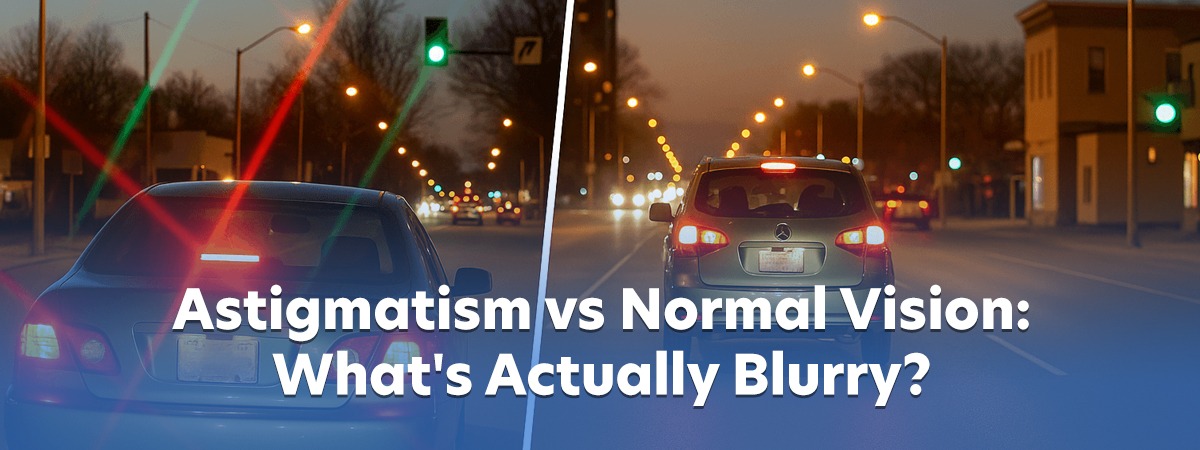
Here’s the thing about good vision: no one appreciates it until a road sign starts playing hard to get. Then suddenly you’re squinting at Exit 13 like it owes you money.
For a lot of folks, that slow slide into blur isn’t aging, or “too much screen time.” It’s astigmatism—one of the most common refractive errors out there, and easily one of the most misunderstood. So, let’s clear it up. Pun intended.
First, the baseline: what “normal” looks like
A healthy cornea—the clear dome at the front of your eye—is round like a basketball. Light passes through, bends evenly, and lands at one crisp spot (focal point) right on your retina. The result is a sharp image, whether you’re reading a prescription bottle or spotting a deer at dusk.
Simple system. Works great.
Now, astigmatism
Imagine that basketball got squeezed into a football. That’s roughly what happens with astigmatism: the cornea (sometimes the lens inside the eye) curves more steeply in one direction than another.
Here’s what that does—the light doesn’t focus on a single point anymore. It lands in multiple places. In front of the retina, behind the retina, or a combination. Your brain receives several fuzzy copies of the same image instead of one clean one.
Things look; blurred, stretched, squished or doubled. At any and all distances. Near, far, doesn’t matter—that’s the signature move that separates astigmatism from garden-variety nearsightedness or farsightedness.
Let me kill two myths and clear up some grammar while I’m here:
- You don’t have ‘a Stigmatism’. It’s Astigmatism.
- Astigmatism is not a disease. It’s a refractive error. You can’t catch it. The shape of your eye is just doing its own thing.
- You didn’t cause it. Reading in dim light, sitting too close to the TV—none of that “causes” astigmatism. Your grandma meant well. She was still wrong.
- Almost everyone has some. Truth is, most eyes carry a small degree of it. It only matters when it’s enough to mess with your day.
Quick side-by-side
| Normal Vision | Astigmatism | |
| Cornea shape | Evenly curved, like a basketball | Uneven curves, like a football |
| Light focus | One sharp point | Multiple scattered points |
| Image quality | Sharp near and far | Blurred, doubled, or streaked |
| Eye strain | Minimal | Notably worse with reading and screens |
Symptoms worth taking seriously
Astigmatism’s can be sneaky. In small amounts, you’ll never notice.
Watch for:
- Blurry or distorted vision at any distance
- Halos or glare around headlights at night—the classic complaint
- Squinting like you’re judging someone
- Eye strain and headaches after reading or screen time
- Kids who “can’t concentrate”—often, they simply can’t see the board
That last one deserves its own spotlight. I’ve lost count of how many school-age kids get labeled as having behavior or attention issues when the real problem was an undiscovered refractive error.
The kids are not ignoring the teacher—they literally can’t read what she wrote. School vision screenings catch a lot, but they miss plenty, and they’re no substitute for a comprehensive exam. Because astigmatism can creep in gradually, plenty of adults walk around for years thinking “this is just how my sight is now.” Doesn’t have to be.
Read Also – Understanding Astigmatism: Causes, Symptoms and Treatment
The fix
Diagnosis requires one thing: a comprehensive eye exam. We’ll measure and test your eyes and nail down exactly what it takes for you to see clearly. No guessing, no eye-chart roulette.
Options for correction run from simple to sophisticated:
Eyeglasses. Specialized lenses that counteract the uneven curvature. Easy and effective. And the frames these days actually look good.
Toric contact lenses. Contacts built specifically for eyes with astigmatism—they stay oriented correctly on your eye instead of spinning around.
Orthokeratology or refractive surgery. For the right candidate who wants something beyond daily correction. Worth a conversation.
Here’s the bottom line: with proper correction, someone with astigmatism sees just as sharply as anyone with “perfect” eyes. The eyeball shape is the quirk. The vision doesn’t have to be.
When to come see us
Notice a pattern? Eyes rotating through: blurry vision, nagging headaches, night driving that’s become an adventure, or kids rubbing their eyes through homework. Astigmatism is gradual by nature, which means waiting rarely improves anything—and with kids, earlier correction protects more than comfort. It protects development.
If you’re looking for an eye exam in Holt, MI—or you’re simply tired of being treated like a chart number—you’ve got a local option… Book your exam at Goodrich Optical today.