
Why Your Eyes Keep Changing Their Minds (And Why It’s Not Just “Getting Older”)
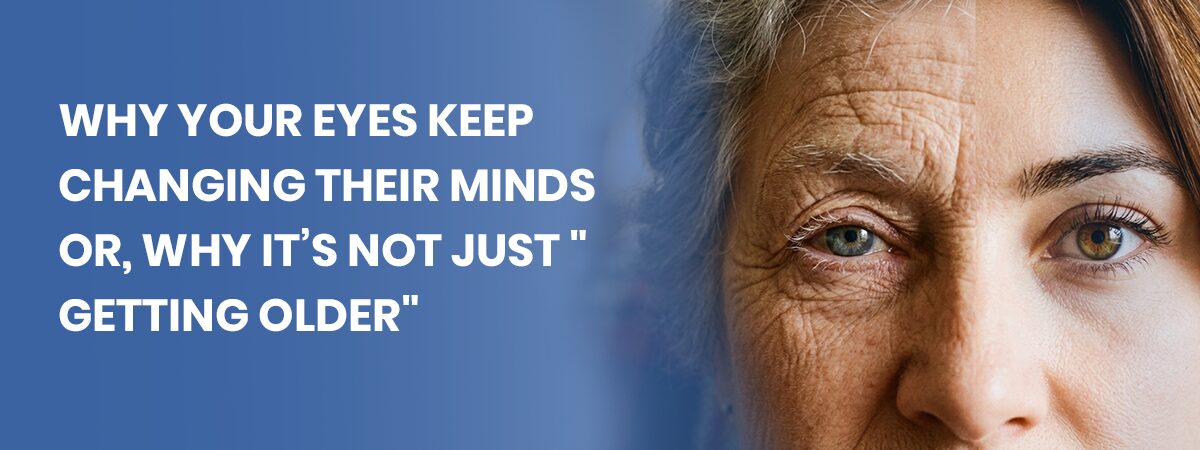
You walk into the exam room expecting the usual: a comprehensive eye health check, quick refraction, maybe a slight tweak to the sphere, and you’re back out the door with a new pair of glasses. Instead, the doctor hands you a slip that looks like a different person’s prescription. “What happened?” you ask. “Did I stare at the screen too long?”
The short answer? Your eyes are not static objects. They are biological machines that never really clock out. They change from childhood through your golden years, and the reasons why your prescription shifts are often more interesting—and sometimes more alarming—than the numbers on the paper.
Let’s cut through the noise and talk about what’s actually going on under the hood, or eye lids.
The Eye Is Not a Statue
Most people believe their eyes settle down after puberty. Wrong. The eye is a dynamic structure that keeps evolving long after you’ve finished growing. Different parts change at different speeds, and each one pulls the rug out from under your prescription in its own unique way. Understanding which part is acting up tells you more than just the prescription numbers ever could.
Axial Length: The Myopia Engine
In nearsightedness (myopia), the culprit is usually the eyeball itself getting longer. The light is focusing in front of the retina instead of on it. During the teenage years, this is mostly about the eye growing faster than the optics can keep up. That’s why myopia control is such a big deal now; slowing that growth in kids can save them from a lifetime of high-risk complications, like retinal detachment.
As adults, the axial length usually stabilizes. But if your prescription keeps creeping up beyond your mid-twenties, pay attention. It’s often benign, but it’s a sign worth tracking, not just correcting and forgetting.
The Lens: The Silent Saboteur
Then there’s the crystalline lens. It’s transparent, flexible, and works overtime to focus your vision. But it has no blood supply, which means it relies on its own internal metabolism – a recipe for trouble as you age.
Normally in your 40s, the lens begins to stiffen. That’s presbyopia. Suddenly, reading a menu requires holding it at arm’s length. It’s not a disease; it’s just biology doing its thing.
But here’s the twist: later in life, that same lens can become more dense, changing its refractive index, and often shifting you back toward myopia. You might find yourself reading without glasses again in your 60s. Sounds great, right? Well, maybe not. This “second sight” is often the first sign of a cataract forming. The lens isn’t getting better; it’s turning cloudy and changing shape. If you’re seeing prescription changes in later life, especially with increased glare or contrast issues, don’t just change your lenses. Have a serious chat about lens clarity.
Corneal Changes: The Shape Shifters
The cornea does about two-thirds of the heavy-lifting for your vision. If its shape changes, your prescription changes.
The big bad here is keratoconus. It’s a progressive thinning of the cornea that turns it into a cone, creating irregular astigmatism that standard glasses can’t fix. It usually hits in adolescence or early adulthood and can masquerade as regular myopia. If the doctor suspects it, you’ll need topographic mapping, not just a refraction.
Then there’s the aftermath of LASIK, or long-term rigid contact lens wear. These can induce subtle curvature changes over time. If you’ve had surgery or wear RGP contacts, periodic topography isn’t just a luxury; it’s a necessity.
Systemic Health: The Hidden Variable
This is where things get serious. Your eyes are often the first place systemic issues show up.
Blood sugar levels have a direct impact on the eye. With diabetes (diagnosed or not), fluctuating glucose causes the lens to swell and change its refractive index. If your prescription seems to jump around or your vision fluctuates during the day, it might not be your eyes; it might be your blood sugar. This is a red flag that needs investigation, not just a new pair of glasses.
Hypertension, thyroid disorders, and medications like corticosteroids can also mess with your prescription by altering the lens or corneal shape.
When to Worry
Most prescription changes are just part of the ride. Gradual shifts over years? Normal. Minor fluctuations? Expected.
But rapid changes, asymmetry between the eyes, or prescription changes accompanied by glare and contrast loss? That’s when you need to raise an eyebrow. If a change doesn’t fit the standard aging narrative, it’s time to look deeper.
Staying Ahead of the Curve
The only way to tell the difference between “normal aging” and “something’s wrong” is regular, thorough eye exams in Holt. At Goodrich Optical in Holt, we don’t just do refractions. We assess ocular health. If your prescription pattern raises a flag, we’ll tell you why.
We’ve been serving the greater Lansing area since 1968. We’ve seen enough prescription histories to know when a change is routine and when it demands a closer look. New glasses are sometimes the answer. But understanding why the prescription changed is always the real conversation.
FAQs
Q1). My prescription changed again. Is that normal?”
Small, steady drift over time is normal. Sudden jumps, asymmetry between eyes, or glare/contrast issues are not normal. Get that looked at!
Q2). Can stress or bad sleep change my prescription?
Not directly. But it can cause eye strain and fatigue that make vision feel off, even when your actual numbers haven’t moved.
Q3). How often should I get my eyes checked if nothing feels wrong?
Once a year for most adults. More often for kids, contact wearers, LASIK patients, or anyone with diabetes. The conditions that matter most rarely announce themselves early.
Q4). Do I actually need corneal topography, or is it an upsell?
If you’ve had LASIK, wear RGP lenses, or keratoconus is suspected, it’s necessary. It shows the cornea’s shape, which a standard refraction can’t.